6.4 Powerstroke Problems in 2008 to 2010 Super Duty Trucks, With Fixes

The most common 6.4 Powerstroke problems are radiator leaks, fuel dilution of the engine oil, high-pressure fuel pump damage from contaminated fuel, cooling system trouble and cracked exhaust up-pipes.


These problems apply to the 6.4L Power Stroke V8 in 2008 to 2010 Ford F-250, F-350, F-450 and F-550 Super Duty trucks.
Ford also recalled early 2008 trucks for a diesel particulate filter that could overheat and a battery cable that could chafe. Below, each problem is tied to its Ford recall, service bulletin or NHTSA complaint record, with the symptom that points to it.
6.4L Power Stroke Problems at a Glance for 2008 to 2010


Use this table to match a symptom to the likely cause before you read the detail sections.
| Problem | Typical Symptom | Documented Fix | Source |
|---|---|---|---|
| Radiator leaks | Coolant loss, wet radiator end tanks | Radiator, plus both thermostats if temperatures misbehave | Ford TSB 09-23-01 |
| DPF overheating | Rough running, white smoke, tailpipe flame | PCM reprogram under recall 07S49 | NHTSA 07V-139 |
| Battery cable chafe | Short to ground, fire risk | Reposition the B+ cable | NHTSA 07V-140 |
| Fuel dilution of oil | Oil level rises between changes | ULSD fuel only, change oil when the level rises | Ford diesel supplement, Diesel Hub |
| Fuel pump damage | Hard start, stall, metal in fuel | Fuel system repair, drain water often | NHTSA complaints, DieselHub |
| Up-pipe cracks | Hissing under load, low power | Replace cracked up-pipes | DieselHub |
| Cooler and front cover trouble | Coolant loss, high oil temperature | Coolant service, cooler or cover repair | DieselHub, NHTSA complaints |
The data visual below groups these failures by the system they start in, which is how a technician usually diagnoses them.
6.4L Power Stroke Problems by System
2008 to 2010 Ford F-250 to F-550 Super Duty
Cooling
Fuel
Exhaust
Electrical
Sources: NHTSA recall records, Ford service bulletins, Ford 2008 diesel supplement and Diesel Hub.
How Many 6.4L Super Duty Trucks Ford Sold From 2008 to 2010
The 6.4L Power Stroke had a short three-year run before the 6.7L Power Stroke replaced it for 2011. That short run is why parts knowledge and fixes come mostly from Ford bulletins and diesel specialists.
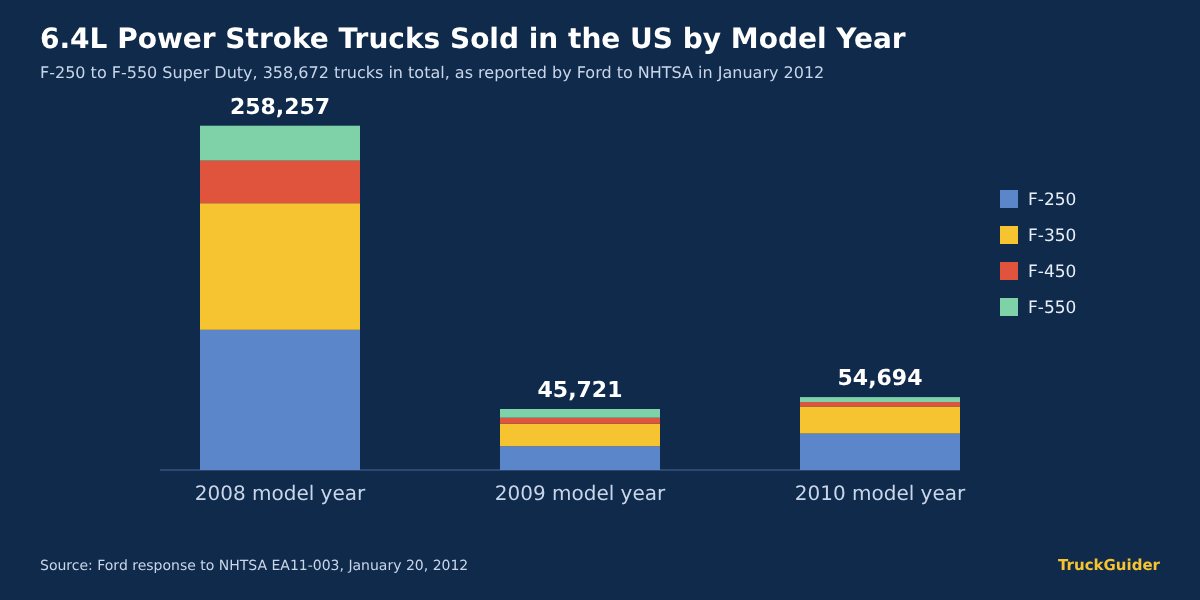
In Ford’s January 2012 peer-vehicle data filed with NHTSA, Ford reported US sales of 258,257 trucks with the 6.4L for 2008, 45,721 for 2009 and 54,694 for 2010. That totals 358,672 F-250 through F-550 trucks.
About 72% of all 6.4L trucks are 2008 models. So most of the complaints and repairs you read about online involve 2008 trucks, simply because there are far more of them. For full output and engine data, see our Power Stroke specs chart by year.
2 Ford Recalls on the 2008 6.4L Power Stroke
Both 6.4L recalls were filed with NHTSA on March 26, 2007. Both cover certain 2008 F-250, F-350, F-450 and F-550 trucks, so 2009 and 2010 trucks are not included.
Recall 07V-139 for DPF Overheating
Ford’s defect report for recall 07S49, logged by NHTSA as 07V-139, covers about 33,169 trucks. Excess hydrocarbons could overheat the diesel particulate filter, or DPF, which traps soot in the exhaust.
Ford listed the symptoms as lack of power, rough running, unusual engine or exhaust noise, white smoke, and possibly a visible flame from the tailpipe.
Ford said it knew of one US report of a tailpipe flame, which alleged a grass fire. Dealers reprogram the powertrain control module, or PCM.
Recall 07V-140 for Battery Cable Chafe


Recall 07V-140 covers about 1,022 trucks. The battery positive cable could rub against the right-hand splash shield bolt, wear through its insulation and short to ground, which raises the risk of a fire.
Dealers inspect the cable routing and reposition it if needed. Run the VIN through NHTSA’s recall lookup to confirm both campaigns are closed on any 2008 truck.
What 78 NHTSA Complaints Say About the 6.4L
NHTSA’s complaint database lists 2008 and 2009 F-250 and F-350 reports by model, not engine. We pulled every complaint for those trucks in November 2026 and kept the 78 unique reports that name the 6.4L or the diesel engine.
The most common themes were stalling or loss of power in 12, fuel pump problems in 11, radiator problems in 8 and turbo trouble in 6. Five mentioned the DPF or regeneration, four mentioned the EGR system and four mentioned fire or flames.
NHTSA returned no 2010 complaints for these models when we checked, so treat 2010 as a data gap. A small count does not prove a problem is rare, because many owners report diesel failures on forums instead of to NHTSA.
Why 6.4 Powerstroke Radiators Leak
Radiator leaks are the best documented 6.4L failure. Diesel Hub’s 6.4 Power Stroke problem guide notes that crimps holding the radiator end tanks loosen over time, and that early builds leaked most often.
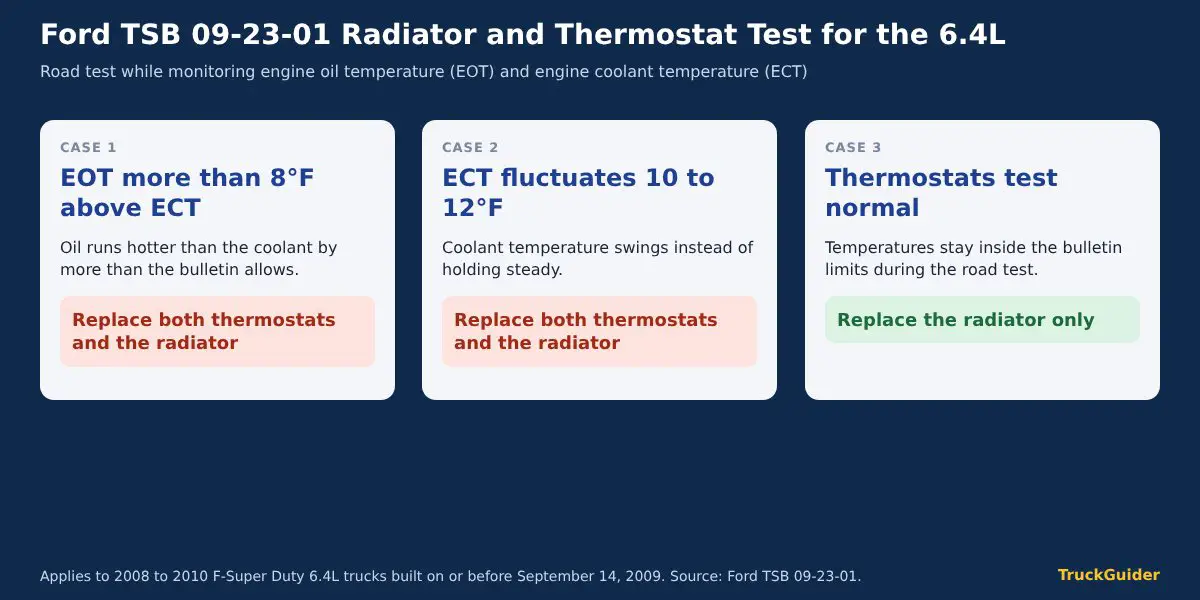
Ford TSB 09-23-01, as reposted on the Ford-Trucks.com forum TSB thread, covers 2008 to 2010 Super Duty trucks with the 6.4L built on or before September 14, 2009. It blames repeat radiator leaks on malfunctioning, hyper-extended high-temperature thermostats.
How the TSB 09-23-01 Test Works
The bulletin tells technicians to road test the truck while watching engine oil temperature, EOT, and engine coolant temperature, ECT. If EOT runs more than 8°F above ECT, or ECT swings 10 to 12°F, both thermostats and the radiator get replaced.
If the thermostats test normal, only the radiator is replaced. Skipping the thermostat check risks a repeat leak, which is the exact pattern the bulletin was written to stop.
How to Spot a Leaking Radiator
Look for crusty coolant residue along the plastic end tanks and a dropping level in the degas bottle. One 2019 NHTSA complaint on a 2008 F-250 says the dealer quoted $1,400 to replace a leaking radiator.
How DPF Regeneration Dilutes 6.4L Engine Oil
Diesel Hub calls the 6.4L the first engine in Ford’s history with a DPF. To burn soot out of the filter, the engine injects extra fuel late in the combustion cycle, a process called regeneration.
Diesel Hub explains that some of that late fuel sticks to the cylinder walls and is carried down into the crankcase. Owners describe the result as the engine “making oil,” because the oil level climbs as diesel thins it.
How Ford’s Diesel Supplement Covers It
Ford’s 2008 Super Duty diesel supplement warns that running low sulfur or high sulfur diesel in the 6.4L, instead of Ultra Low Sulfur Diesel, increases the likelihood of oil dilution that may lead to major engine damage. Ford adds that damage from improper fuel is not covered by warranty.
The same supplement calls for SAE 15W-40 or 5W-40 oil above 50°F and keeps the same change interval for synthetic oil. Diesel Hub recommends checking the dipstick often and changing the oil at once if the level rises.
How Short Trips Make It Worse


Idling and stop-and-go driving trigger more frequent regenerations. Long highway runs let regeneration finish, which cuts both fuel dilution and the fuel economy penalty owners report.
6.4L Fuel Pump Failures From Water and Gasoline
The 6.4L uses high-pressure common-rail injection, and its high-pressure fuel pump has very tight tolerances. Water or gasoline in the fuel can destroy it and spread metal debris through the system.
Diesel Hub warns that water can mix with diesel into a sludge that clogs the fuel-water separator drain, letting water pass into the fuel system. It recommends draining the separator far more often than at filter changes.
Fuel Failures Owners Report to NHTSA
A September 2026 NHTSA complaint describes a 2008 F-250 with the 6.4L suffering a catastrophic fuel system failure, later traced to gasoline in the diesel. Ford’s supplement states plainly that gasoline, gasohol or alcohol must never be added to diesel fuel.
Fuel System Bulletins From Ford
Ford TSB SB-21434, listed in NHTSA’s bulletin records on July 1, 2010, tells technicians to use only the hybrid-style washer, part W303659, on fuel lines at the high-pressure pump.
Diesel Hub also cites TSB 07-26-2 for harness wires that can chafe against the pump on trucks built before August 20, 2007.
3 Cooling Failures Beyond the 6.4L Radiator
Coolant problems on the 6.4L rarely stop at the radiator. Diesel Hub lists two more, and four of the NHTSA complaints we reviewed mention the EGR system.
EGR Cooler Leaks
The exhaust gas recirculation, or EGR, cooler uses engine coolant to cool exhaust before it re-enters the intake. Four of the 78 NHTSA complaints mention the EGR system, so it belongs on any coolant-loss checklist.
An internal leak lets coolant disappear without an outside drip, and white exhaust smoke may follow.
Oil Cooler Clogging
Diesel Hub links a clogged engine oil cooler to coolant breakdown. Symptoms include a check engine light with a related trouble code and, in severe cases, engine derate.
Front Cover Cavitation
Diesel Hub reports that collapsing vapor bubbles in the coolant can erode holes through the front cover. It recommends keeping the coolant additive concentration up and flushing on Ford’s schedule.
Our 6.4 Powerstroke sensor location diagram shows where the EOT and ECT sensors sit if you want to log the readings yourself.
How Cracked Up-Pipes Hurt 6.4L Performance
The up-pipes carry exhaust from the manifolds to the turbochargers. Diesel Hub says their accordion-style expansion joints fatigue under heat and vibration, then crack.
Diesel Hub lists a loud hiss under load and a noticeable loss of power as the symptoms, because exhaust escapes before it reaches the turbos.
How a Clogged 6.4L DPF Shows Up
Diesel Hub lists DPF clogging as a separate 6.4L problem. It happens when regeneration fails or when ash builds up from fuel that is not ULSD or oil that is not a CJ-4 low-ash grade.
Regeneration can burn off soot but not ash. Diesel Hub says an ash-clogged DPF has to be removed and cleaned, so use ULSD fuel and a CJ-4 low-ash oil to keep ash buildup slow.
Which 6.4L Symptom Points to Which Problem
Use these if-then checks to narrow a problem before you pay for diagnosis.
- If the coolant level drops and the radiator end tanks are wet, check the radiator and run the TSB 09-23-01 temperature test.
- If coolant drops with no outside leak and white smoke appears, suspect the EGR cooler.
- If the oil level rises between changes, suspect fuel dilution from regeneration or a fuel leak.
- If the truck stalls or will not restart and the fuel smells wrong, check for water or gasoline in the fuel.
- If you hear a loud hiss under load with low power, inspect the up-pipes.
- If the truck runs rough with white smoke on a 2008, confirm that recall 07S49 was completed.
Should You Buy a 6.4L Super Duty Today
A 6.4L truck can be a fair buy if the paperwork shows the problem areas were handled. Ask for proof of both 2008 recalls, a radiator and thermostat history, and regular oil and fuel filter service.
Have a diesel technician scan the PCM, check coolant and oil condition, and inspect the up-pipes before purchase.
If you would rather avoid these risks, our 6.7 Powerstroke problems guide covers the engine that replaced the 6.4L for 2011. If you are weighing an older 6.0L truck instead, our 6.0 Powerstroke problems by year guide covers that engine.
Your 6.4 Powerstroke Problems Checklist
Most 6.4 Powerstroke problems trace back to heat, coolant and fuel quality. Radiator leaks and fuel dilution are the issues to watch first, and both have documented fixes in Ford’s own bulletins and diesel supplement.
On any 2008 truck, confirm recalls 07V-139 and 07V-140 are closed. On every 6.4L, keep to ULSD fuel, drain the fuel-water separator often, check the oil level between changes and run the TSB 09-23-01 temperature test if coolant goes missing.
Those habits will not make a 6.4L trouble-free, but they target the failures owners and Ford have documented most. Pair them with a pre-purchase scan and recall check, and a 6.4L can stay a capable towing truck.
5 Common Questions About 6.4 Powerstroke Problems
What Is the Most Common 6.4 Powerstroke Problem
Radiator leaks are the 6.4L problem Ford documents best. Ford TSB 09-23-01 covers trucks built on or before September 14, 2009, and links repeat leaks to faulty high-temperature thermostats. In NHTSA complaints, stalling and fuel pump failures come up most often.
Which 6.4 Powerstroke Year Is Best
No primary source ranks one 6.4L year as clearly better. Every 2009 and 2010 truck avoids the two 2008 recalls, and trucks built after September 14, 2009 fall outside the radiator bulletin, which Diesel Hub says reflects improved later radiators.
Why Does 6.4 Powerstroke Oil Level Rise
The oil level rises when diesel from DPF regeneration reaches the crankcase and dilutes the oil. Ford’s diesel supplement says non-ULSD fuel raises that risk, so use ULSD only. Diesel Hub advises changing the oil as soon as the level climbs.
Did Ford Recall the 6.4 Powerstroke
Yes, Ford filed two recalls for certain 2008 trucks in March 2007. Recall 07V-139 reprograms the PCM to stop DPF overheating on about 33,169 trucks, and 07V-140 repositions the battery cable on about 1,022 trucks. Neither recall covers 2009 or 2010 trucks.
How Many 6.4 Powerstroke Trucks Were Sold
Ford told NHTSA it sold 358,672 F-250 through F-550 trucks with the 6.4L in the US from 2008 to 2010. Of those, 258,257 were 2008 models, about 72%, so most reported problems involve 2008 trucks simply because there are more of them.